Socialinsider is making a strong case for becoming your analytics bank, thanks to social media strategy becoming the new currency for marketers in 2026. Socialinsider, a Romanian-built SaaS platform, has spent nearly a decade quietly doing what many bigger, louder tools have only promised: turning raw social media numbers into actual strategic intelligence.
We have to sit and wait to see whether Socialinsider will earn a permanent seat at the strategy table. It might just remain like other analytics dashboards in an already crowded market. Let’s explore this software, shall we?
Why choose Socialinsider?
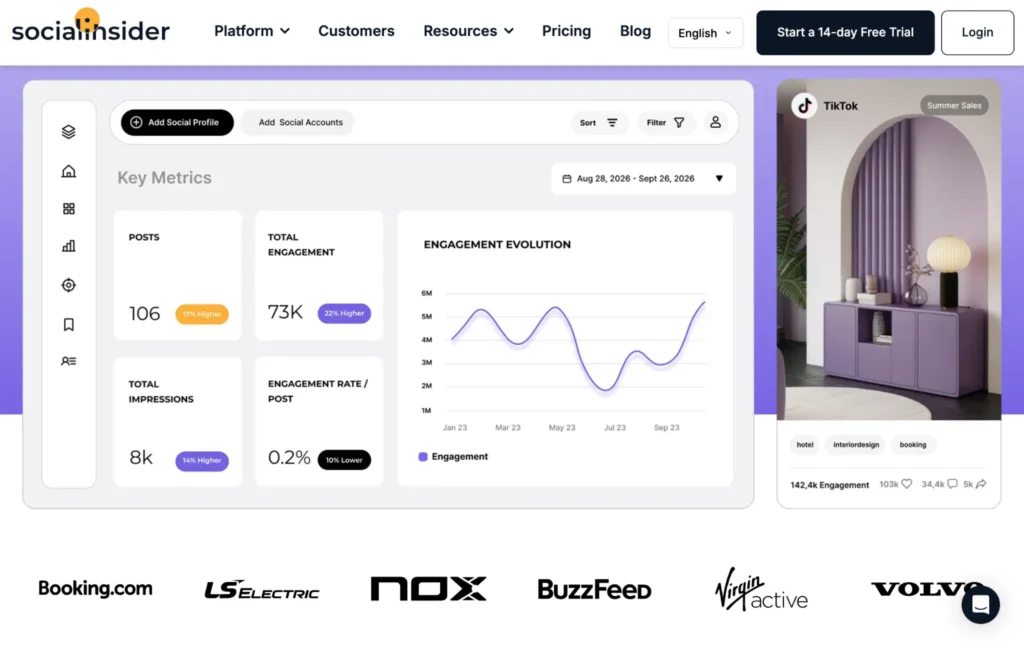
Socialinsider is a social media analytics and competitor benchmarking platform built for marketing teams and agencies who are serious about data-driven strategy. However, unlike the more general-purpose tools in this space (think Hootsuite or Buffer), Socialinsider does not try to do everything; it focuses on a few select purposes. You might be disappointed to see that it neither schedules posts nor manage your inbox. What it does instead is go very, very deep on analytics, competitor intelligence, and content performance, and it does that with a level of precision that most all-in-one tools simply cannot match.
The platform’s core promise, “lead with social media analytics, not assumptions,” is not just marketing copy, but reflects an interesting product philosophy: that the biggest problem in social media management is not the lack of tools for posting content, but the lack of reliable data for making decisions about what to post, when, and why.
For agencies managing multiple client accounts, brand strategists building competitive intelligence reports, and social media managers who need to benchmark their performance against industry standards, Socialinsider offers a useful solution. And if you’ve been piecing together insights from native platform analytics, spreadsheets, and gut feeling, this tool will feel like a breath of fresh air.
Socialinsider’s Pros and Cons
Strong points
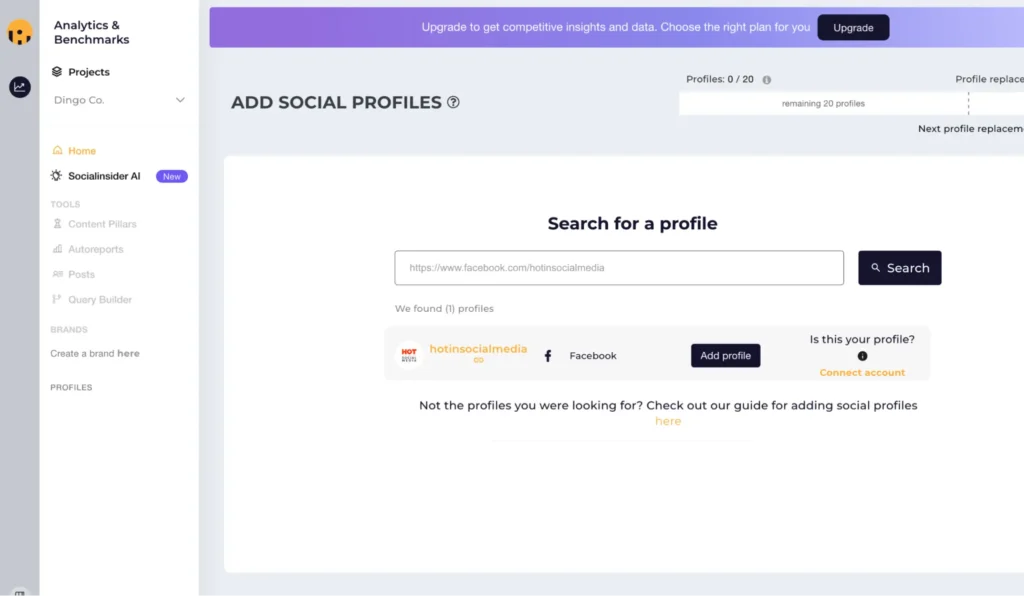
Socialinsider’s most compelling feature is its competitor analysis capability. You can add any public social media account, without needing access credentials, and immediately pull that account’s performance data into your dashboard: you get engagement metrics, content breakdowns, cross-channel comparisons, post-level analysis, and even content pillar identification for competitor profiles.
The content tagging system is another strong point. The combination of manual post tagging and auto-tags (where you define a keyword or hashtag once, and every matching past and future post gets tagged automatically) makes it possible to run campaign-level performance analysis without the usual manual effort. I would say that marketing agencies will appreciate it as an operational time-saver.
Socialinsider is also great at reporting: white-label reports are available on all plans (not just the premium tiers), one-click chart and data exports are easy to use, and scheduled automated reports mean you are not scrambling every month to pull data for clients.
One customer reduced reporting time from a full day down to one to two hours, and that claim is easy to believe once you’re inside the platform.
The AI Executive Summary feature is a welcome addition that automatically turns account and benchmark data into strategic recommendations, saving the interpretive work that usually falls to the strategist. It is not perfect, but it is a good thinking prompt.
What surprised me was that the platform’s cross-channel coverage (Facebook, Instagram, TikTok, LinkedIn, X/Twitter, and YouTube) is available in a single unified dashboard, even though I mostly focused on Instagram in my review. Native analytics per platform are disconnected and inconsistent; having it all in one place with comparable metrics is itself a significant advantage.
Weaknesses
There are real limitations here, and they are worth flagging honestly.
The base plan restricts historical data to just three months. For anyone wanting to spot longer trends or do year-over-year comparisons, that means upgrading to at least the Predict plan to access 12 months of history. Not cool if you are evaluating the tool for strategic seasonal analysis.
The single seat on the Adapt plan is tight. Even a two-person social team would need to upgrade or pay the $15/month per-seat add-on immediately. Agencies managing teams will likely find themselves on the Predict plan simply because of the seat count, so factor that into the total cost calculation.
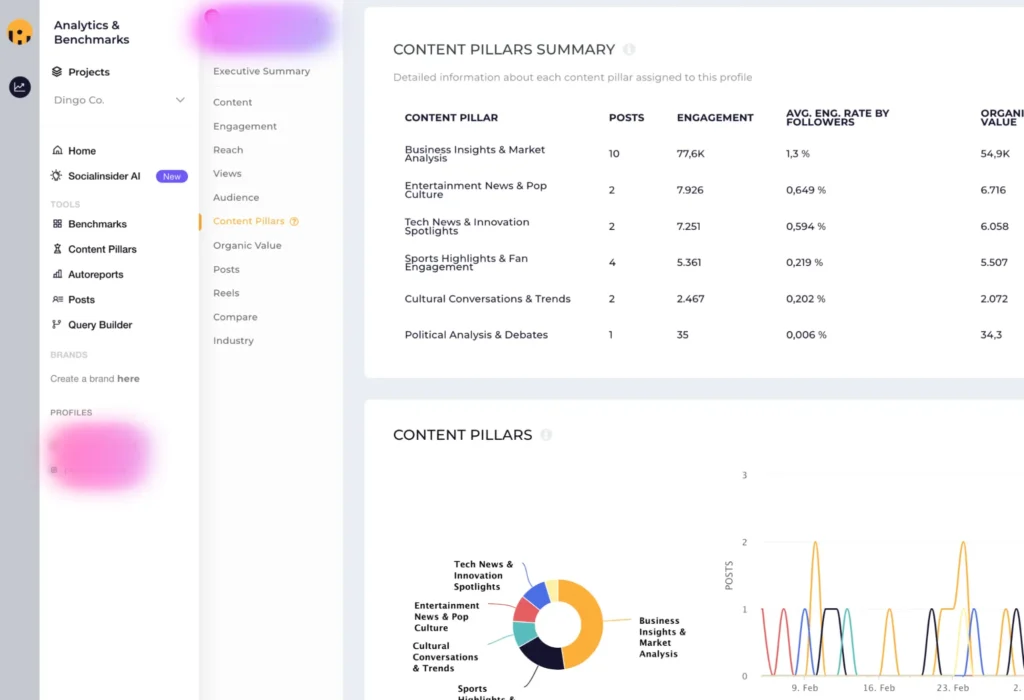
The AI Content Pillars cannot be renamed or restructured. The AI automatically assigns content categories, and that’s that. If you disagree with its categorization, your only option is to manually build custom pillars via auto-tagging.
Similarly, the AI auto-assigns an industry to each profile, and users cannot currently change that designation (the team has acknowledged this is still in development), and since it’s a platform that heavily markets itself on AI, these are notable limitations.
Again, Socialinsider is not a publishing or scheduling tool. If you are looking for an all-in-one social media management platform, this is not it. Socialinsider is an analytics-and-intelligence platform, and it is best used alongside (not instead of) your scheduling workflow.
Socialinsider’s use cases
Socialinsider is purpose-built for users whose primary job is to understand performance, not to produce content. And those who understand (raw) metrics.
It’s not a shocker that marketing agencies are the most natural home for this tool. If you’re a solo act, maybe managing 20 to 40+ client accounts from a single dashboard, generating white-labeled reports, and running competitive analyses for each client are workflows more suited to big companies. Tribal Worldwide, for instance, manages 40 client accounts inside the platform, and it’s easy to see why agencies with that kind of volume would gravitate toward a dedicated analytics solution.
From what I’ve noted, brand strategists and social media managers at mid-to-large companies are the ones using Socialinsider to build quarterly competitive intelligence reports and identify content gaps relative to competitors. The platform’s ability to compare your account against brands you admire (not just direct competitors) makes it useful for aspirational benchmarking as well.
There’s also a content analysis and tagging module that allows users to isolate the performance of specific campaigns, content themes, or formats and make editorial decisions based on actual engagement patterns rather than instinct.
Socialinsider’s top 3 features
1. Competitor analysis and benchmarking
Competitor analysis and benchmarking are Socialinsider’s crown jewels. The ability to track any public account across six platforms, with no account ownership required, and compare it side-by-side against your own performance is kinda powerful. You can run head-to-head comparisons, benchmark against industry averages, identify a competitor’s strongest platform, and drill all the way down to individual post-level analytics, owing to the fact that the platform even provides a built-in seven-step competitive report framework, which is a nice touch for teams who want a structured approach to presenting findings.
It’s better than a basic competitor tracking thanks to its depth of analysis: you can cross-reference competitors’ top posts by caption length, format, platform, and content theme (not just by engagement numbers), which gives you actual strategic intelligence rather than a vanity metrics comparison.
2. Content tagging and AI Content Pillars
The content analysis module combines two complementary workflows: AI-generated content pillars (automatically categorized themes based on your posting history) and a manual/automated tagging system for custom campaign groupings. Together, they let you answer the question that matters most in content strategy — which themes actually drive results?
The auto-tag feature is particularly practical. Define a keyword or hashtag once, and Socialinsider retroactively tags all matching posts in your history and continues tagging new ones going forward. No manual cleanup, no retroactive data entry. For campaign tracking and post-campaign analysis, this is a serious time-saver.
All in all, this makes content analysis and content tagging a strong feature of Socialinsider.
3. Reporting and white-label exports
Socialinsider’s reporting workflow is impressively frictionless. Every chart, comparison, and dataset in the platform can be exported in one click. Reports are white-labeled on all plans, not just the top tier, which is a significant advantage for agencies that need to present polished deliverables to clients without a Socialinsider watermark at the bottom. Scheduled automated reports add another layer of convenience, and the Looker Studio integration opens the door to embedding social data into broader business intelligence dashboards.
What users say about Socialinsider
User sentiment on G2 is largely positive, with the platform earning a 4.7 out of 5 rating based on 130+ reviews, and users frequently highlight how much time it saves on manual research and report preparation. One customer from Create Media reported saving over $16,000 per year on reporting costs alone, which is the kind of ROI claim that resonates with agencies evaluating the business case, albeit the case study was published on their website.
What people criticize is the pricing and accessibility for smaller teams, as well as the limitations of the base plan, particularly the single-seat and three-month data window. Also, there’s a learning curve to make the most of the competitor analysis and tagging features, which is fair; this is not a tool you can open and intuitively master in an afternoon.
Socialinsider vs. the Competition
Socialinsider occupies a specific niche: it is an analytics and intelligence tool, not a social media management platform. That shapes every comparison below.
Hootsuite and Agorapulse offer publishing, scheduling, inbox management, and team collaboration — features Socialinsider does not have. If you need an all-in-one management suite, neither Socialinsider nor its analytics peers are direct replacements. However, Socialinsider’s competitor benchmarking and content analysis go significantly deeper than what Hootsuite or Agorapulse offer in their native analytics tabs.
Sprout Social is the closest like-for-like competitor in the analytics space, offering robust reporting and some competitor tracking features. However, Sprout Social’s pricing starts at $199 per month per seat, making Socialinsider considerably more accessible for mid-market buyers who need competitive intelligence without an enterprise budget.
Brandwatch is the enterprise-grade social listening and analytics giant. Socialinsider itself has positioned against Brandwatch in recent content, framing itself as the right choice when you need social performance benchmarking and competitive data rather than deep enterprise listening across the broader web. Brandwatch wins on social listening breadth; Socialinsider wins on speed of setup, pricing, and the depth of its social-specific benchmarking.Brand24 competes in the social listening space but focuses primarily on brand mention monitoring rather than on performance benchmarking, making it a complementary tool rather than a direct rival.
Price and cost comparisons
Socialinsider uses a monthly and annual-billing model with four tiers:
- Adapt: €89/month (€74/mo if paid annually): 20 social profiles, 3 months of historical data, 1 seat
- Optimize: €129/month (€108/mo if paid annually): 30 profiles, 6 months of history, 2 seats
- Predict: €209/month (€174/mo if paid annually): 40 profiles, 12 months of history, 5 seats
- Enterprise: custom pricing for custom volume
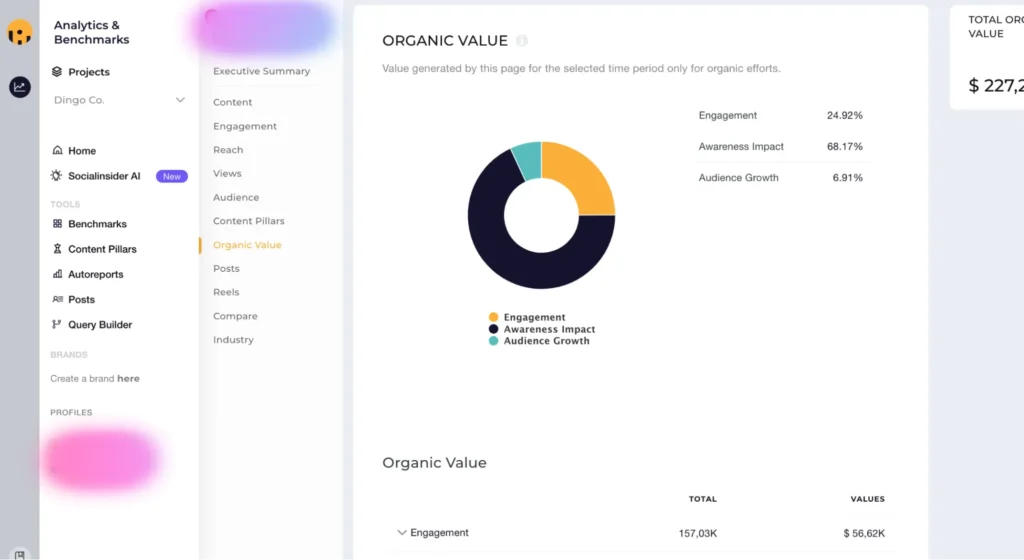
All plans include cross-network analytics, competitor benchmarking, automated and white-label reports, unlimited exports, and priority support, which is somewhat generous for an entry plan. The 67% of users who reportedly start on Optimize speaks to the plan’s usefulness.
That said, the add-on cost structure is worth watching closely. For agencies with larger teams and more complex data needs, the real monthly outlay can climb quickly above the headline plan price: check for yourself using the Enterprise calculator.
The 14-day free trial with no credit card required is an advantage; you can evaluate the full platform before committing to an annual contract, which is the right way to buy a tool at this price point.
Privacy and security
As a Romania-based company operating under EU jurisdiction, Socialinsider is GDPR compliant by default, which is a meaningful baseline for European users and any business handling personal data under EU regulations. The platform uses encrypted connections for data transfers and standard cloud security protocols.
Socialinsider pulls data from public social media accounts for competitor analysis — so there is no third-party account access involved in that workflow, which reduces the data risk profile compared to tools that require full OAuth access to accounts you don’t own.
Caveat: as with any cloud-based platform, no system is entirely impervious to security risks, and users should evaluate their organization’s security requirements accordingly.
Product updates and releases
Socialinsider maintains a steady monthly product update cadence, publishing detailed change logs on its blog.
For example, recent milestones include the launch of Socialinsider AI in October 2025, which brought conversational AI querying and AI-generated executive summaries to the platform.
January 2026 saw the publication of their comprehensive Industry Benchmarks Study and improvements to the accuracy of the AI Content Pillar, and by February 2026 it shipped contextual in-dashboard How-To Guides, refined the Looker Studio integration, and added new sorting options for the Views and Estimated Views metrics.
The update rhythm is consistent, and the direction is clearly AI-forward, which is the right bet for an analytics platform competing in 2026.
Company evolution
Socialinsider was founded in 2016 in Bucharest, Romania, by Andrei Șerbănoiu, Răzvan Vișan, and Adina Jipa, and formally incorporated in January 2017. What makes their story stand out in a SaaS landscape dominated by VC-funded competitors is that Socialinsider was built as bootstrapped: no outside investment, no growth-at-all-costs mindset, just a lean team building a focused product.
Răzvan Vișan brought 12 years of experience at Bitdefender (Romania’s leading cybersecurity firm) to the founding team, lending the company technical rigour that is evident in the reliability of its data pipelines. The team grew their customer base through organic SEO, positioning themselves as a data authority in the social media analytics niche (I doubt they relied on paid acquisition). Their more recent move into programmatic SEO, using their proprietary dataset to generate benchmark resources accessible to visitors before they ever sign up, is smart pivoting.
Their scale-up phase took place in 2023–2024, when the founders brought in a Fractional CFO to establish financial oversight processes that the company had outgrown its startup-mode workarounds for. That transition paid off: 2024 saw a reported 50% growth in their customer base, their biggest year to date. As of 2026, Socialinsider operates as a team of 11–50 people, celebrating its 10th year.
Final verdict
Socialinsider isn’t for everyone, and it doesn’t try to be. For social media professionals who need more than the built-in analytics dashboards offer and are willing to pay for higher-quality data and more detailed reports, this is a focused, well-built analytics and competitor-intelligence platform.
It’s a great choice for agencies in this price range since it includes white-label reporting on every plan, the ability to manage multiple accounts, the ability to track competitors across any public profile, and useful AI-powered insights that make it a valuable tool for everyday business.
The Adapt plan’s single seat and three-month data window may seem too small for solo social media managers or small teams with limited budgets. You’ll want to trial the platform carefully and map your specific reporting needs against what each tier actually provides before committing to a yearly contract.
Conclusion
If your social media strategy is built on instinct and native insights, Socialinsider will show you what you’ve been missing. If you’re already data-driven and just need better tools to scale that workflow, Socialinsider will feel like home.
Is it the right tool for all social media professionals? No. If you need a single platform that has publishing workflows, inbox management, and team collaboration features, you should look at the all-in-one players in this space. But if your main issue is figuring out why your content isn’t doing well, why your competitors are beating you, and what the data is really saying about your next move, Socialinsider is the tool for you.