Keeping up with AI in marketing these days can feel like a full-time job on its own. New tools are popping up constantly, each one promising to save you time, boost performance, or completely change the way you work. And while some of them are genuinely impressive, the reality is that it’s still surprisingly hard to find tools that actually make a difference once you start using them day to day.
A lot of AI platforms look great at first glance. You try them, maybe even get excited about a few features, but after a while, you realize they don’t quite fit into your workflow, or they solve problems you don’t really have. And when you’re already juggling campaigns, deadlines, and performance targets, the last thing you need is another tool that adds more complexity instead of removing it.
That’s exactly why I wanted to put this roundup together.
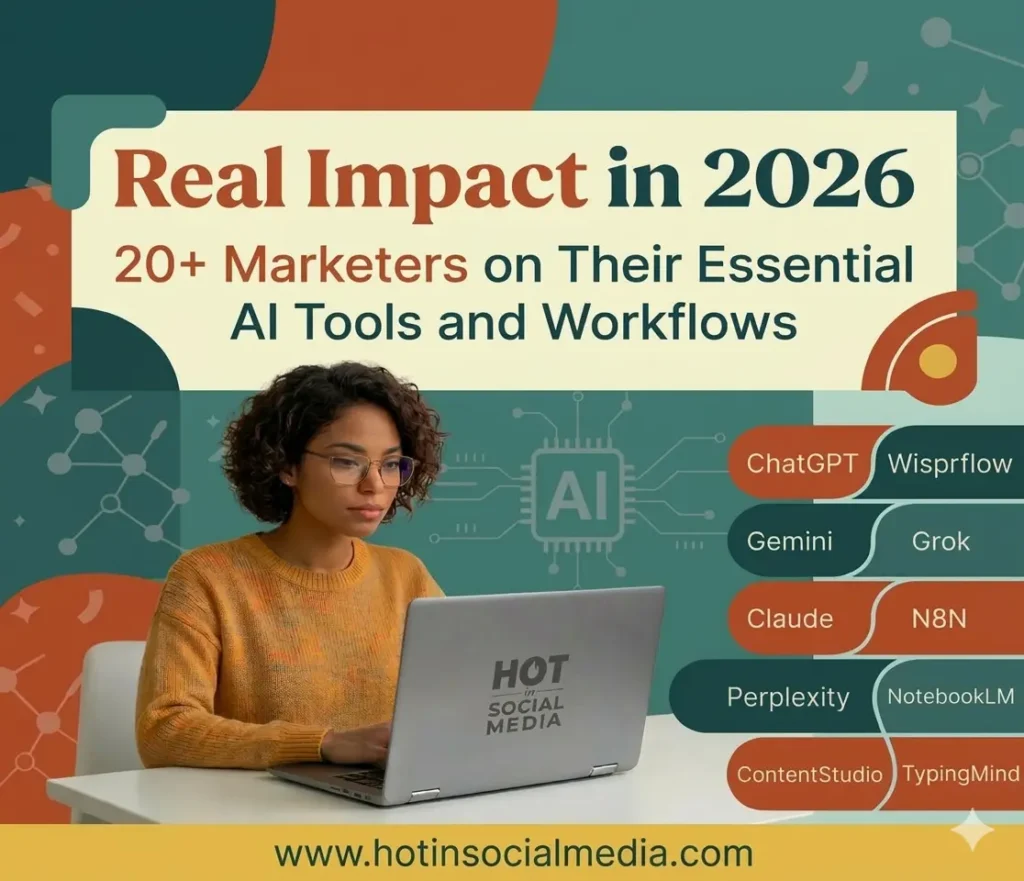
Instead of talking in general terms about what AI could do, I asked over 20 marketers a simple, practical question: how are you actually using AI in your workflows in 2026, and which tools are creating real business impact for you? The answers are based on their own experience — what they use, what they trust, and what’s genuinely helping them get better results.
My hope is that you’ll find at least a few ideas, tools, or approaches here that you can take and apply to your own work.
And before you dive in, I just want to say thank you once again to all the marketers who took a bit of their time to share their experience with the Hotinsocialmedia community. If you find something useful in this article, I’d really appreciate it if you shared it on your social media channels! 🙏
How are you using AI in your marketing workflows in 2026, and which tools create real business impact?

My 2026 Workflow: The “Human Insight” Loop
In my world, AI isn’t a content creator; it’s a research assistant and an operations manager. If you’re using AI to write your social posts, you’re losing. If you’re using it to find the reason to write a post, you’re winning.
The Impact Stack: Insight, Context, and Pulse
– Passle (The Content Anchor): This is where the “real” work happens. Passle is my engine for capturing authentic thought leadership. I don’t use it for generic SEO; I use it to get our experts to comment on industry shifts in minutes. It creates the trust-based assets that are us create conversations with buyers.
– Gemini (The Strategic Architect): I use Gemini as my context engine. I feed it my Passle insights and ask it to “fragment” them for different audiences. It takes a technical legal or consulting post from Passle and helps me rewrite the “hook” for a CFO on LinkedIn versus a tech lead on Threads.
– Grok (The Real-Time Pulse): Grok is my cultural radar. Because it has live access to X, I use it to see what people are saying right now about a topic we just blogged about on Passle. If Grok shows a heated debate on X, I’ll take that “vibe” and jump into the conversation with our expert link.
– The “Multi-Platform” Relay: My workflow is a hub-and-spoke model. Passle is the hub; LinkedIn, X, Threads, BlueSky, YouTube, and TikTok are the spokes. I use AI to ensure the tone of the Passle insight is native to the platform, cozy and conversational for Threads, direct and sharp for X, and authority-driven for LinkedIn.
The Overhyped: “AI-First” Content Creation
– Prompt-to-Post Automation: If the AI is the one coming up with the idea, you’ve already lost. In 2026, the feed is flooded with “perfect” AI articles that say nothing. I reject tools that “write the blog for you.” If it didn’t come from an expert’s brain via Passle, it’s not worth the pixels it’s printed on.
– The “One-Size-Fits-All” Social Bot: Tools that blast the same message across LinkedIn and BlueSky are brand-killers. BlueSky and Threads, in particular, have a “bot-detector” culture. If you don’t use AI to localize your message to those specific communities, you’ll be blocked.
Conclusion
AI in 2026 is a force multiplier, not a replacement. I use Passle to capture the ‘soul’ of the brand, the expertise and the evidence. Then I use Gemini and Grok to make sure that soul is visible across the entire social spectrum. The real impact isn’t in the AI’s ability to write; it’s in its ability to help me be more human, more often, on more platforms.

We use AI everywhere we can to increase speed, clarity, or precision, but not at the expense of originality. The biggest areas:
- Research acceleration: let AI handle the first-drafts, competitive scans, and content audits so you can start with insight instead of a blank page.
- Creative iteration: Instead of replacing creativity, AI gives us 20 versions of an idea in minutes. We choose the best direction and refine from there.
- Personalization at scale: AI helps us adapt messaging across verticals, industries, and buyer stages, keeping the core narrative consistent while tailoring the details.
- Workflow automation: AI handles routing, tagging, summarizing, and reporting so we can spend more time on strategy and less on legwork.
The tools that matter most are the ones that plug into our existing systems and remove bottlenecks, not the ones that promise “full automation.” In 2026, the real business impact comes from AI that enhances, extends and lightens our team workload, not replacing the team.

Using AI has become essential in my workflows over the past two years, but I see it as a strategic layer, not a replacement for expertise.
For me, AI is most powerful when used for research, synthesis, and structured decision support. The real breakthrough isn’t just content generation, it’s productivity compression. Tasks that used to take hours of analysis, clustering, or hypothesis building now take minutes.
We use a mix of ChatGPT, Claude, Perplexity, and Gemini, often orchestrated through automation workflows in n8n. It’s not about picking a winner. Each model performs better for specific tasks, whether that’s deep reasoning, data extraction, competitive analysis, or structured outputs.
The biggest impact comes from automated workflows where AI supports high-leverage decisions, like search intent clustering, SERP pattern analysis, objection modeling, and experiment ideation. That dramatically increases our speed to execution and testing velocity.
AI doesn’t replace strategy.
It amplifies marketers who understand search psychology, conversion mechanics, and business priorities.
That’s where the real advantage is.

As fast as AI is evolving, I’ve not tapped-out what I’d like to be doing and what is possible. Can we get an “AI Holiday” where we can add 24 hours to a day sometime soon to get it done? 😉
What I have used AI for most:
+ Research – market and topic
+ Help polishing text in a chapter for a book anthology project
+ Brainstorming social media strategy and content plan themes
+ Surfacing alt text for images
+ Optimization of some work
In addition, I belong to a business professionals group that has access to customized AI tools created specifically by an AI engineer for our purposes.
Examples:
+ Public speaking – Creating presentations in my personal or business voice to optimally engage an audience
+ Business development – Team building, performance reviews, all types of marketing content, recruiting and hiring, and more
+ Course content – Maximizing retention and utilizing it for engaging our business connections
Tools I like – short list:
+ The customized AI mentioned above
+ ChatGPT, Gemini, Claude
+ Perplexity (Basic and Pro)
+ Wispr – Speak instead of type
+ Canva
For important projects I will use ChatGPT, Gemini and Claude together. Depending on the content type, I’ll use one as the base for the work and ask another how it would improve on the other.
I’m intrigued by tools like personal clones or “Ask AI,” and something I’ve seen lately: AI-created historical figures based on uploaded historical documents, allowing you to converse with and ask questions of them. Ever want to have a conversation with Abraham Lincoln? It’s possible right now! Imagine the possibilities for your business . . .

Whether it’s drafting a landing page, video script, email campaign, or running competitive research, I no longer start from a blank state thanks to AI.
I can ask Claude to show my competitor’s top pages using Ahrefs MCP or feed Claude Code some Figma mock-ups, blog articles, and internal notes to design a landing page.
Those assets are not ready to ship. I still need to edit 50-60% of their content based on my product marketing experience. But the execution is faster. And the best part is that the AI continuously adapts to my work.
Neal Schaffer
6x Marketing Author (Digital Threads, Maximizing LinkedIn for Business Growth)

At this point, AI is so embedded in how I work that pulling it out would be like going back to doing accounting by hand.
My go-to LLM is Claude, and I use it less for content creation and more for thinking. For instance, when I was scaling a Facebook Lead Ad campaign recently, I was feeding it cost-per-lead data by country and working through expansion scenarios and creative analysis together. That’s not AI replacing me — that’s having a sharp analyst available at midnight when I’m staring at my ad dashboard.
For social media, I’m using ContentStudio’s Brand Knowledge feature to keep my voice consistent when automating posts across platforms. That’s where AI in marketing is really headed — not generating generic content, but learning your brand well enough to help you scale without sounding like a robot. ContentStudio is also one of the first social media dashboards that I know of that actually has an MCP integration with Claude. This is clearly the direction the industry is heading.
My podcast workflow is where AI saves me the most time. Riverside’s built-in AI handles filler words, audio cleanup, text-based editing — all stuff that used to be a tedious backlog. Now my job is to show up and have a good conversation.
Finally, while I mentioned that Claude is my go-to LLM, I also frequently use Typing Mind as an LLM dashboard of sorts to help me discover the best LLM for any particular business objective through being able to test multiple LLMs simultaneously.
Bottom line: the AI tools that matter aren’t the ones that create content for you. They’re the ones that remove friction so you can focus on the parts that still need a human.

Well-designed workflows use AI to organize ideas, connect tasks, and clear up confusion at the start of a project. AI is a strong partner during the early brainstorming phase, helping turn rough ideas into a clear plan. AI agents can test our thinking and help us spot gaps in it.
We don’t need more tools that just write or design for us. What we really need are tools that help us understand complex concepts and explore new directions before we start creating.
In practice, this means getting our mental energy back. We use these tools to save time on routine, research, and other automated processes, so we can focus on expansion. When we have more time to improve our services, learn new skills, and focus on high-value work, our impact compounds because we finally have the freedom to make the strategic changes that move us forward.
When machines handle the structure and organization, we protect the judgment. That’s the difference. The impact doesn’t come from having the most advanced tool. It comes from using the right ones to free us to do the work only humans can do.

In 2026, my AI “stack” is a lot simpler than people expect. I’m not running elaborate automated workflows or stacking ten different AI tools on top of each other. I’m using AI intentionally… primarily as a thinking partner, not as an autopilot.
The tool I use most consistently is ChatGPT. I use it to pressure-test ideas, refine positioning, challenge my assumptions, tighten language, and explore angles before I publish. It’s a collaborative sounding board that helps me move from idea to clarity faster. It doesn’t replace my voice… it sharpens it. That distinction matters.
Beyond that, my AI use shows up in light-touch ways inside platforms I’m already using… transcription and summarization. I’m not chasing every new tool. I’m focused on tools that remove friction so I can spend more time engaging with clients, followers, friends, and the broader marketing community. That’s where the real business impact happens for me… in conversations, not dashboards.
AI helps me prepare better, think deeper, and respond faster… it gives me leverage. But the growth comes from relationships… from replying to comments, from thoughtful DMs, from showing up consistently, and from being present in the rooms that matter.
The biggest mistake I see marketers making in 2026 is over-engineering workflows in search of scale while underinvesting in connection. I’m not interested in automating authenticity, ’m interested in protecting it.
The tools that create real impact are the ones that support human judgment, not replace it. AI should help you think more clearly, communicate more effectively, and create more time for meaningful engagement. If it’s not doing that, it’s probably just adding noise. For me, AI is a multiplier… not a substitute. It helps me execute RETURN ON RELATIONSHIP more consistently… it doesn’t define it.

AI in 2026 feels less like a revolution and more like infrastructure.
I use it to accelerate the parts of marketing that do not require intuition. Research synthesis. Competitive analysis. Pattern recognition in performance data. Outline structuring. Repurposing frameworks. It compresses hours into minutes. That time compression is valuable because it creates space for strategic thinking.
What I do not use AI for is final voice. If something reads like it was generated, it weakens authority. Audiences can sense generic language immediately. AI is powerful when it supports clarity. It becomes dangerous when it replaces judgment.
The real business impact comes from how AI integrates into workflow. Automated segmentation inside a CRM. Smarter attribution analysis across channels. Faster insight into which hooks and messages are actually converting. AI surfaces patterns. Humans decide what to do with them.
The tools themselves matter less than the thinking behind them. ChatGPT for structured research and idea expansion. Strong CRM systems for lifecycle automation. Analytics platforms that connect revenue to effort. Editing tools that streamline production. None of these create growth on their own. They create leverage.
In 2026, the competitive advantage is not access to AI. Everyone has access.
The advantage is clarity of strategy and the discipline to use tools as amplification, not substitution.
The marketers who win are not louder.
They are clearer.

At AIclicks, AI is embedded in how we track and respond to brand visibility.
In practical workflow terms, the tools creating real impact are the ones that remove decision-making lag. AI for content structuring and drafting, automation for lead qualification and follow-up sequences, and systematic tracking of where and how AI mentions your brand versus competitors.
The mistake most teams make is using AI to produce more content faster. The teams winning use AI to understand what content actually influences decisions and then produce less, but better. Volume without strategic input just creates noise.
From the tool list, I’d list Clay, n8n, Claude Code, and Lovable.
AI’s value in 2026 is judged by its ability to shift metrics that matter: CAC, conversion rate, retention, and pipeline velocity, and not just content volume. I see the best CMOs in my portfolio embed AI into decision workflows like insights, segmentation, and personalization rules. Combining that with automation loops of multi-channel sequencing or dynamic creative optimization. Leading tools are those that integrate tightly with first-party data and business systems (CDPs, CRM, ABM platforms) to ensure outputs are not isolated artifacts but actionable signals. Generative content is an accelerant, but business impact comes when it’s married with measurement frameworks and automation that governs relevancy and compliance.
AI tools that deliver real impact are those with clear roles in execution + measurement symmetry. Tools that generate content without auditability or conversion tracking are tactical at best. The winners in 2026 are AI systems that:
- Reduce cycle time for hypothesis testing;
- Surface causal insights rather than correlations;
- Automate high-leverage tasks (dynamic creative, multi-variant testing, predictive scoring);
- Embed guardrails so outputs are coherent with brand and commercial constraints.
This isn’t about doing the same old things faster but rather it’s about reconfiguring workflows so strategic priorities like distribution, monetization, and retention are artifacts of the tooling itself, not just outputs.

In our marketing department, we use AI tools to streamline as many workflows as possible. For instance, our content team relies on AI to brainstorm ideas, create article outlines, and proofread final drafts. When it comes to data analysis, we frequently turn to Gemini to generate complex Google Sheets formulas.
On a personal level, I use Wispr Flow constantly, as voice commands are far more efficient for me than typing. Meanwhile, our data specialists use n8n to automate lead enrichment, saving hours of manual work and ensuring the sales team has full context before their first call. However, regardless of the automation, a human always performs the final quality control.

AI is embedded in our daily operations. We use it for automated reporting and analysis across all our Google Ads accounts – what used to take hours now takes minutes. We’re building toward offering automation as a standalone service for clients (launching Q3/Q4).
The tools creating real impact: Claude Code for workflow automation, server-side integrations for data quality, and AI-assisted ad copy generation.
The key insight: AI works best when it has a rich business context – we maintain detailed client profiles so AI recommendations are specific, not generic.

The simple answer: I’m using AI to save time.
The longer version: I’m using AI in the brainstorming process, I’m structuring my ideas with it. I’m also using AI in interpreting analytics and making sure I’m getting the best results possible for my content.
As for tools, I truly think SocialBee’s AI features help a lot, but also the classic ChatGPT/Claude AIs are great “assistants”.

We’re barely scratching the surface of what AI can do for marketers. Content and image generation get all the attention, but the real shift is in how it’s weaving into everything else: integrated workflows, deep research, and my personal favorite: learning.
A year ago, I couldn’t do half the things I do now. AI helps me pick up new tools, edit videos, and go deep on research in a fraction of the time. For a small team wearing multiple hats, that’s the real superpower.
Which tools? A Frankenstein setup like most teams. But the impact isn’t in the stack. It’s in what it enables. We’re relaunching a product sunset in 2021 with a fraction of the resources it originally needed. That wouldn’t have been possible two years ago.
I use AI heavily for research and first-draft ideation; it’s brilliant for getting from a blank page to something you can really work with. Claude has become my go-to for that.
For content repurposing, I’ve been using AI to turn long-form pieces into multiple formats quickly, which has been a real time-saver. On the analytics side, tools that use AI to surface insights from data (rather than just presenting dashboards) are where the value is.
The key shift for me has been treating AI as a collaborator in the workflow rather than an output machine, the quality difference between AI-generated content and AI-assisted content is night and day, and audiences can absolutely tell.

AI should stand for “average information” because those short, lazy prompts don’t give responses that are specific to your audience and their emotions. The fix is to train the AI on your audience first, then prompt. So the best AI workflows for marketing include personas.
Don’t have personas? No worries. AI can help you make them.

AI is part of many stages of our workflow, but we use it as a collaborator instead of a replacement. It helps us speed up research, analyze large sets of social data, and identify patterns that would take much longer to spot manually. For example, we use Socialinsider AI assistant to get quick answers to metrics on social and get insights from it instead of spending hours analyzing the data.
We also use AI to support content production, especially for structuring ideas, generating variations, and testing angles. The key is that the final layer always comes from a human perspective. That’s where differentiation happens.

AI has become invaluable in the ideation phases of work for my clients and me! Among other things, it helps with:
- Providing lists of potential blog post topics.
- Summarizing transcripts of podcast episodes so I can create social media posts more efficiently.
- Writing basic first drafts of video scripts.
- Suggesting how to break big ideas into carousel posts or post series.
I mainly use ChatGPT – mostly out of habit and comfort. But Claude, Gemini, and Notebook LLM have been gaining my attention lately.

In our team and for clients (medium to large teams), we’re heavily invested in leveraging Canva’s AI and design-driven Creative Operating System. This brings together Canva’s Visual Suite of tools, Brand System and Magic Studio features in the one place (saving on tech-stack!) to let you scale your brand and personalise marketing content.
Canva’s Brand System lets you more effectively manage your brand at scale, while new features like Canva Grow let you scale powerful campaigns and ads. The impact of bringing everything in-house with these powerful tools is game-changing for teams and we’re excited to see what’s next with new releases coming in 2026.

AI is our strategic co pilot, not a content factory.
We use it to audit performance data, identify customer journey friction, pressure test campaign ideas and build structured playbooks and SOPs. It accelerates decision making and shortens feedback loops.
The brands outperforming in 2026 are not the ones chasing automation. They are the ones using AI to think better, move faster and execute with clarity.

It’s time to move on from chatting with AI about your work to having it do your work. I’m impressed by how most LLMs have advanced in the last few months, especially Gemini.
We are pushing these LLMs with field testing. As they change, we want to know which are strongest for our applications, such as creating AI agents that truly work for us.
In some cases, these agents are built into industry-specific software, but we’re mostly creating them using known models, apps, and harnesses. We’re learning a lot about harnesses lately, and how they replace vibes-based results with quantifiable data.

It’s time to move on from chatting with AI about your work to having it do your work. I’m impressed by how most LLMs have advanced in the last few months, especially Gemini.
We are pushing these LLMs with field testing. As they change, we want to know which are strongest for our applications, such as creating AI agents that truly work for us.
In some cases, these agents are built into industry-specific software, but we’re mostly creating them using known models, apps, and harnesses. We’re learning a lot about harnesses lately, and how they replace vibes-based results with quantifiable data.

AI is useful for removing the tasks that were eating time without adding value. Where I push back is on using it to replace the human judgment calls that customers can actually feel.
People know when the empathy is real and when it was generated. That distinction matters more now than it ever has.

Kimberly Reynolds
Senior Paid Social Specialist & Co-Founder, AI Advantage Agency
Most marketers use AI to produce content faster. I use it to produce content that AI engines cite as a source. That distinction drives everything about how I’ve built my workflow.
The pipeline works like this: Claude generates AEO-optimized blog posts using a codified system I built, structured with dual FAQ schema, answer-ready formatting, and architecture designed specifically to earn citations in AI-generated responses, not just Google rankings. GPT Image via Magai.co handles image generation.
Once published, Zapier automatically submits each URL to Google Search Console for immediate indexing and logs the post to a Google Sheet that acts as a live content database.
That Sheet feeds a custom HTML tracker I built, which pushes formatted LinkedIn posts into Buffer via the Anthropic API. The only manual step is adding the image before publishing. That’s intentional.
We started publishing in mid-February. By mid-March, AI citations to our domain had spiked 25-30x, now running 500-660 daily across ChatGPT, Perplexity, Claude, and others, across 118 unique URLs.
Our FAQ, Guides, and Services pages rank among the most cited, which confirms that structuring content for how AI engines consume information works.
The lag is real. AI engines don’t cite you immediately. They cite you once they decide to trust you.
The competitive advantage in 2026 isn’t showing up in Google. It’s becoming the source AI trusts when someone asks your category’s most important questions.