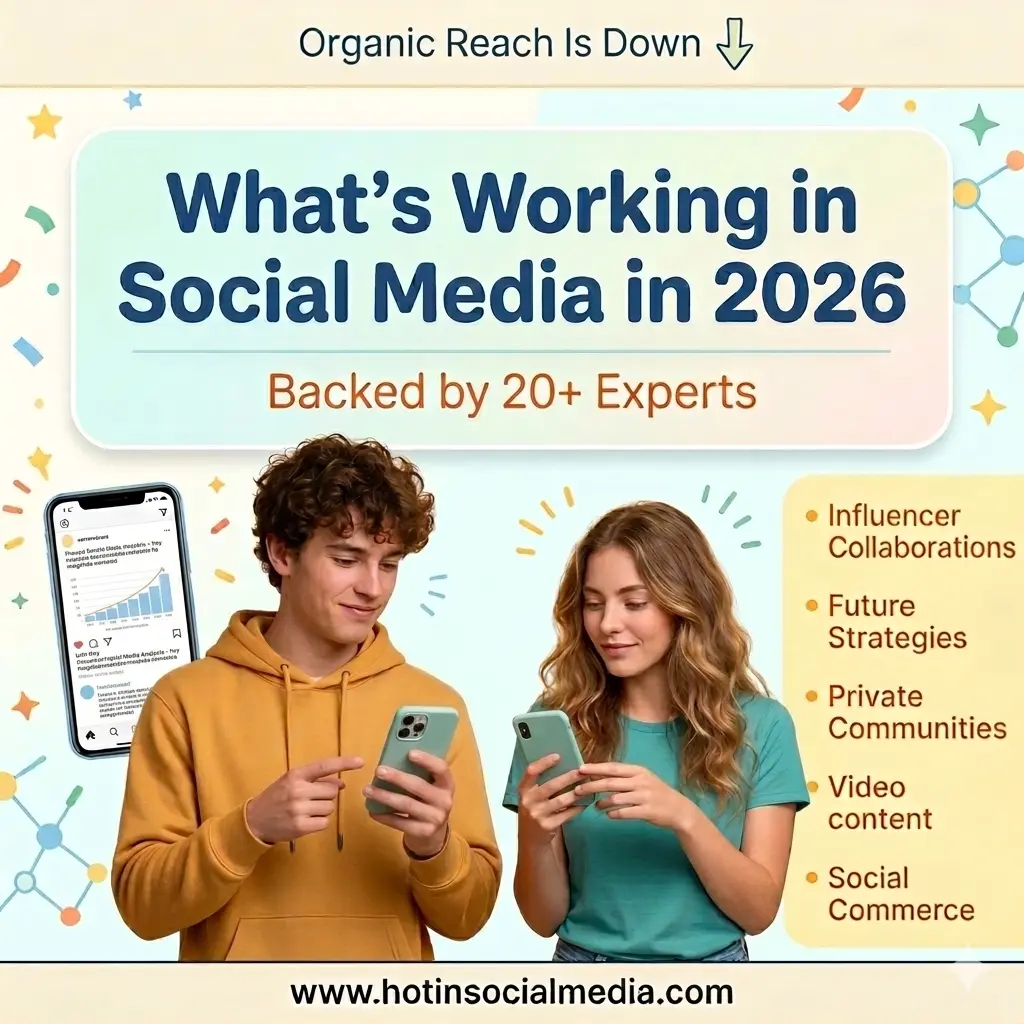
If you work in marketing or manage social media for a business, you’ve probably noticed the same thing many others have in the past few years: getting organic reach is getting harder and harder. Almost every major platform has been gradually reducing how much content people see without paid promotion, and this trend hasn’t slowed down in 2026.
At the same time, the amount of content published every day keeps growing. In the last year, especially, AI tools have made it incredibly easy to create posts, videos, and graphics much faster than before. The result? Social media feeds are more crowded than ever, and even good content can struggle to get noticed.
For businesses and creators, this means that simply posting regularly is no longer enough. Competition for attention is high, algorithms keep changing, and what worked a year ago may not work today. That’s exactly why it’s useful to look at what other marketers are actually doing in practice. Real experiences, experiments, and lessons learned in the field can often be far more helpful than general advice you see repeated everywhere.
In this social media marketing tips for 2026 roundup article, 20+ marketing specialists from different countries share the social media tactics, ideas, and approaches that are working for them right now. Their answers include practical advice and proven strategies that you can quickly adapt and apply to your own business or projects.
If you’re looking for fresh inspiration and actionable ideas that go beyond theory, this collection of expert insights will hopefully give you a few strategies worth testing.
A big thank you to all the marketing experts who once again responded positively this year and generously shared their insights for this article. 🙏
And if you discover at least one idea that you find especially useful, feel free to share the article on your social media accounts and tag Hotinsocialmedia. We truly appreciate your support! 🚀
What social media strategies are delivering real growth in 2026, despite declining organic reach and rising competition?
Neal Schaffer
6x Marketing Author (Digital Threads, Maximizing LinkedIn for Business Growth)
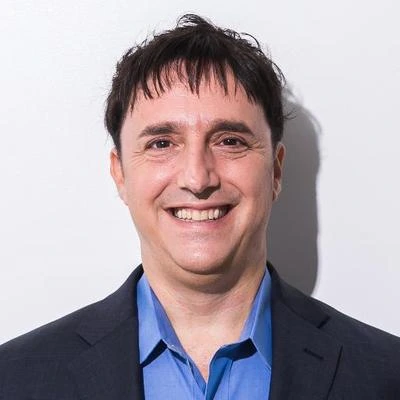
I’ve been doing this since 2008, and the organic reach decline conversation has been happening for a decade now. So I think the better question is: what are you doing with the attention you do get?
The biggest shift I’m seeing — and doing myself — is treating social media as the front end of a lead generation system. I’m running Facebook Lead Ads right now, where I acquire an email subscriber for about a dollar, and that person goes into a nurture sequence where I build a real relationship over time. You don’t need massive organic reach when you’ve got even a modest ad budget pointed at a real conversion goal. That frees me up to use organic social what it was meant for: relationship building.
LinkedIn is the other big one, especially for B2B. I keep saying this, and people keep sleeping on it. Newsletters on LinkedIn are quietly one of the best organic distribution tools on any platform right now, and most businesses aren’t even using them.
And then repurposing. I know it sounds boring, but I record one podcast episode, and it becomes a blog post, LinkedIn content, email content, and short-form video clips. The businesses I see struggling are trying to create something original for every platform every day. You don’t need more content — you need a better system for the content you’re already making.
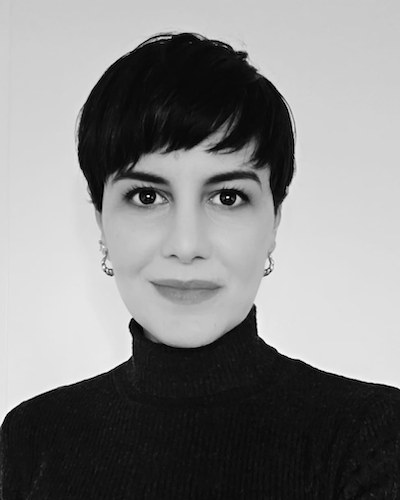
Organic reach only “declines” when we treat social media like a megaphone. Growth is about reaching the right person in the right room.
One of the biggest drivers of growth now happens out of sight, where tracking tools can’t reach (allegedly). The most meaningful sharing is happening in private spaces like DMs, group chats, and small circles. People can grow tired of public performance. Privacy isn’t as private as it used to be, and many favor content that feels safe to share among trusted friends. In a noisy world, a real recommendation from a peer is still the filter people trust most.
We no longer need more content. We need fewer, sharper ideas. We can write less and still say much more, trading the hollow volume of daily posting for the weight of a clear, human experience. This also means sharing ideas worth screenshotting, forwarding, or remembering.
When we write for people instead of algorithms, we invite real conversation and build an authority that exists outside of a feed. Intellectual recognizability, staying true to our principles and perspective over time, is what produces trust that outlasts any fleeting format. Since no one can remove the noise, we build above it.
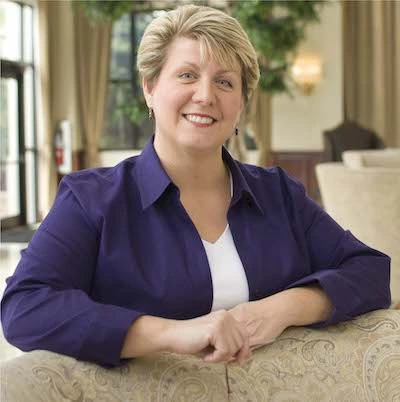
* Actually Having A Social Media Strategy
Too many brands assume what works for one company will work for their business. Or, they are working from an outdated strategy. In both cases, results will be low or dwindle. Smart brands audit their processes at least once a year (quarterly is better) and draft a new social media strategy with a refreshed content plan each year (again, reviewing at least quarterly). That allows a team to work with a clear goal. It also keeps your company evolving with technologies and best practices instead of falling behind.
* Multiple Forms & Types of Content
A mistake I often see public figures and business brands make is a lack of content variety. They publish only article links or only long social media posts. The reality: It exhausts your audience, and they begin to ignore your brand online.
People like variety. An optimal content plan offers multiple types of content for engagement. Offer videos, photos, multi-photo posts, colorful graphics and infographics, insightful articles, helpful PDFs … Just for starters. More importantly, vary post length so people can engage easily or go deeper when they have time. If YOU see the same thing day in and day out, you get bored, right? Same goes for your fans and followers.
* Video
Video still gets the most engagement. Now, we need to implement various types of video into our social media strategies. Formal and informal. Both informational and fun. Use long-form, video shorts and live video. Offering tips, behind-the-scenes, interviews, customer testimonials, milestone moments and animations engages your followers in different ways. The world is a blank canvas begging for your creativity. Use it!
* Private Communities
More and more brands are moving their social interactions to communities hosted on their own websites. Some require a paid subscription, others do not. And they are thriving! Brand teams engage fans around conversations that are about them, humanizing the brand and celebrating their enthusiasts. It is fresh and fun and beats the digital pollution sometimes found on major social networks. Yes, those brands are still on social media. But they lead people to their own hosted community. For some of their followers, it’s replacing social media.
We’ve all felt social media overwhelm at some point. And now keeping up with AI is overwhelming for many. In 2026, social media strategies that focus on people’s needs and wants will win. It’s about being human. It’s all about connection.
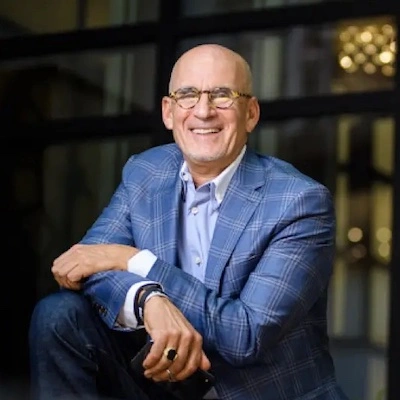
Declining organic reach isn’t the real problem in 2026…declining intentionality is. It’s easy to blame the algorithm when distribution drops and competition rises, but the leaders seeing real growth aren’t obsessing over reach… they’re obsessing over relationships. Everyone can create content at scale now… AI has leveled THAT playing field. What hasn’t been leveled is care, discernment, and the willingness to engage consistently and meaningfully.
The strategies driving real growth this year aren’t hacks or format tricks. They’re rooted in human presence. The brands and individuals winning understand that community beats audience every time. An Audience Consumes… a Community Participates. That difference shows up in the comments, in the DMs, in the follow-ups, and in the way people talk about you when you’re not in the room. Short-form video still works. Creator collaborations still work. AI-assisted optimization still works. But only when those tools amplify a clear point of view and real human connection. If the content feels hollow, the algorithm may distribute it briefly, but it won’t sustain it.
Too many companies are blaming “declining reach” while quietly reducing real engagement, cutting community budgets, and automating touchpoints that once built loyalty. You can’t automate trust and then complain that growth feels transactional. The algorithm didn’t kill your reach… in many cases, inconsistency, sameness, and lack of relational investment did.
Organic Reach may be shrinking, but Relational Reach is not… Reputation still compounds. Familiarity still compounds. Trust still compounds. The leaders driving sustainable growth in 2026 are the ones who treat social platforms like rooms they’re walking into, not billboards they’re renting. They listen, they respond, they show up repeatedly… they understand that engagement isn’t a metric to optimize, it’s a muscle to strengthen.
Machines can help you publish faster and analyze smarter. They can support strategy and surface insight. BUT THEY CAN’T CARE. And in a crowded digital world filled with noise, caring, consistently and visibly, is still the ultimate growth strategy. That’s RETURN ON RELATIONSHIP in action.
The narrative that organic reach is dead is convenient. It removes responsibility. It blames the algorithm.
What is actually happening is simpler. Passive content no longer spreads.
The social media strategies producing real growth right now are built around conversation, not broadcasting. Posts that ask sharper questions, take clearer positions, and invite thoughtful replies are outperforming safe, neutral content. Algorithms are increasingly designed to reward engagement that signals depth. Depth requires substance. Substance requires perspective.
Another pattern I see repeatedly is disciplined distribution. The marketers scaling fastest are not scrambling for new ideas every day. They are extracting full value from strong ones. A single insight becomes a video. That video becomes a carousel. That carousel becomes a long form article. That article becomes an email. Distribution is no longer about presence everywhere. It is about coherence everywhere.
There is also a recalibration happening around audience size. Large, passive followings are impressive on paper but weak in conversion. Smaller, aligned audiences who respond, share, and engage create predictable growth. Depth of relationship is outperforming breadth of reach.
And perhaps most significantly, founders who show up personally are outperforming brand accounts that hide behind logos. Trust in institutions is fragile. Trust in individuals with consistent conviction is stronger. Personal presence has become a growth lever.
Organic is not dead. Generic is.

The Growth Drivers: Depth Over Distance
In a year where organic reach has plummeted to single digits, the only way to grow is to stop “broadcasting” and start triggering conversations.
- The “Founder-Led” Growth Engine: The most potent social strategy in 2026 is the Personal Brand of the leadership. A corporate logo has no “reach” because it has no “soul.” Growth happens when founders and team members share their “messy middle”, the failures, the lessons, and the raw expertise. In 2026, people follow people, not PDF-style corporate updates.
- The “Dark Social” Bridge: The growth of this is now invisible. Real results happen when your content is so insightful it gets screenshotted and shared in a private WhatsApp or Slack group. Your strategy would focus on creating “Referrable Content”, posts that aren’t meant to get a thousand likes, but are designed to be the “source of truth” in a private board meeting. Empowering your sales people and employees to create and share such content is where human connection and conversations happen. And think about the reach.
- Social SEO (Search-First Content): As everybody is on social media, we know that social media is the new Google. Growth in 2026 comes from being the answer to a specific “how-to” or “why” query. By optimizing your profile and captions for intent-based keywords, you bypass the “feed” and show up in the discovery engine. In 2026, buyer should see your svlesteam as problem solvers at the centre of their network and industry. When this happens buyers walk towards, sellers and ask for help. In 2026, this is business as usual (BAU) for many companies, not some future state.
- Micro-Communities (The “1,000 True Fans” Approach): Rather than chasing a million followers, you’d advocate for niche dominance. Growth comes from being the “big fish” in a small, highly engaged Slack community or LinkedIn group. It’s better to have 500 people who treat your word as gospel than 50,000 who don’t remember your name.
The “Ghost” Growth: Why These Strategies Are Failing
Be careful, tactics that look like growth on a spreadsheet but feel like spam in the feed.
- Mass Repurposing (The “Everywhere” Trap): You’d argue that being on every platform is the fastest way to be nowhere. Copy-pasting a LinkedIn post to TikTok and Instagram doesn’t work in 2026. Each platform has a different “vibe.” If you aren’t native to the channel, the algorithm, and the audience, will ignore you.
- Over-Polished “High Production” Video: People are fatigued by “TV-style” social ads. The more expensive your video looks, the more people will swipe past it. Authentic “lo-fi” video, recorded on a phone with real insights, is what drives growth because it builds trust, not just views.
- AI-Generated “Engagement”: Using bots or AI tools to “warm up” profiles or leave generic “Great post!” comments is a brand-killer. In 2026, the algorithms are smarter than the bots. This doesn’t just fail to drive growth; it gets your account suppressed by the social media platforms and blocked by the very people you are trying to influence.
Conclusion:
If you’re worried about declining reach, it’s probably because you’re still trying to ‘hack’ the algorithm instead of ‘helping’ the user. In 2026, growth isn’t about how many people see you, it’s about how many people can’t stop talking about you when you aren’t in the room. Social selling isn’t about reaching more people; it’s about being more reachable to the right people.
Growth today comes from depth, not breadth. The big unlock this year is a shift from chasing reach to building micro-communities and repeatable engagement loops.
3 approaches that are paying off big right now:
1. Creator-driven distribution, not mega-creators, but niche voices who already hold influence in the exact problem space your audience cares about. Their credibility cuts through sinking organic reach.
2. Conversation-led content, posts built to spark discussions, not just passive impressions. Algorithms have been increasingly rewarding meaningful engagement more than anything else.
3. Platform-native storytelling, noticing a shift from brands and creators moving away from repurposed assets, and instead designing content specifically for app-specific vertical video, social search, and AI-powered discovery feeds.
And the most underrated strategy? Letting your subject-matter experts be visible. People buy from humans they can learn from, not brand accounts.
When it comes to social media strategies for B2B businesses, I recommend:
- Investing in building personal brands for founders and key employees.
- Actively contributing to corporate social media channels.
At PRNEWS.IO, we prioritise building a strong thought leadership presence on LinkedIn for me and my co-founder, Alexander Storozhuk. As our focus is on maintaining a close rapport with our audience, we invest heavily in regularly publishing high-quality content. When I say “high-quality”, I genuinely mean it: every post and every article we share is based on our personal experience and our clients’ stories. We aim to provide our audience with something unique.
When it comes to corporate social media channels, the strategy is, once again, to maintain a regular presence with relevant information. On one hand, it is a way to share news with our followers. On the other hand, it provides an opportunity to send verified signals about our brand to AI systems that will later integrate these signals into their answers. It is a win-win situation.
Real growth comes from strategies that treat social platforms as distribution channels, not destinations. The shift is from broadcasting to networked amplification, where audiences become active co-distributors through product-led hooks like tools, templates, and playbooks. And incentive-aligned creator partnerships. High-impact strategies leverage systemic loops: owned content designed to trigger paid and creator syndication automatically, with clear tracking of LTV > CAC. CMOs today are constructing distribution architectures where each post feeds multiple flywheels such as search, newsletter, community, and partnerships, reducing reliance on platform algorithms alone.
rowth is also driven by precision signals and first-party data orchestration. Given declining organic reach, the only way to sustain growth is by segmenting high-intent cohorts and tailoring narrative sequences that convert. That means investing in lightweight, scalable CRM + social-linked attribution, and embedding social triggers into the commercial funnel (e.g., gated tools, micro-courses, playbook downloads). The strategy isn’t volume of posts, it’s signal velocity & optimization loops of rapidly testing hypotheses, validating value before scaling, and ruthlessly pruning non-performing channels.

Implementing SEO strategies on social media channels (social SEO, as we’re calling it at SBN Marketing) is what’s dominating organic social media these days for several reasons, including:
- The decreasing importance of hashtags across all social outlets.
- The reduction of the hashtag limit to 5 on Instagram.
- Social media outlets increasingly becoming where top-of-funnel searches happen, especially with younger users.
Social SEO requires a bit more work, but when properly implemented, it’s worth it! Key steps to social SEO are:
- Keyword research.
- Appropriate keyword concentration within post copy.
- Post copy written for humans, not algorithms.
- Optimizing all elements of all social media outlets – not just post copy, but also bios, about sections, descriptions, etc.

According to our latest 2026 Social Media Benchmarks, we see that engagement is dropping on platforms like Instagram and Facebook. But on the other hand people are saving and sharing more content. I think this shows a trend of silent engagement in 2026.
People are still paying attention, they’re just interacting differently. A save or a share signals intent. It tells you the content was useful enough to revisit or valuable enough to pass on. That’s where real growth is coming from right now.
The strategies that are working are built around that behavior. Educational content, practical insights, and formats that people want to come back to are performing consistently. Carousels, guides, and structured posts that deliver clear value tend to drive more saves.

Organic reach is essentially pay-to-play now. What works: using paid social strategically to amplify content that was validated organically first, rather than boosting everything. For B2B clients, LinkedIn paired with email marketing outperforms Meta for lead quality.
For e-commerce, Meta’s Advantage+ campaigns combined with strong creative testing deliver consistent POAS.
The real growth lever isn’t a platform trick – it’s having proper tracking and attribution so you actually know what’s working.
In a world where everyone is using the same AI tools to churn out content, authenticity has become a massive competitive advantage. I’ve noticed this personally while scrolling through LinkedIn. You see so many generic, AI-written posts that don’t actually say anything new. They lack the “scars” of real experience. Writing from a place of “I lived this” is something AI still can’t replicate, and that’s what people are actually stopping to read.
Beyond just being “real,” we’re doubling down on brand. In a saturated market where two tools might look identical on paper, people will always choose the one they recognize and trust. At Flipsnack, we’ve started to value this more than ever. We’re investing heavily in the human side of social media: the individual profiles of our key team members, strategic influencer collaborations, and platforms like Reddit or Quora. These forums are especially vital now because they directly feed into the answers AI models give to users. If you aren’t part of the conversation there, you aren’t part of the AI’s response either.
I’d say Audience-first content (that solves your audience’s problems) is a great way to build a community. Keeping strategic content pillars will save you time and effort in the long run and provide structure to your content.
Collaborative content is also a great way to build relations and grow audiences.

The brands winning right now are the ones that turned their customers into the content strategy. User-generated content, customer spotlights, and advocacy that happens because people genuinely want to share.
That cuts through in a way polished brand content no longer does. Organic reach is down, but credibility from a real customer still travels.
This one’s personal for me. I’m currently marketing a SaaS that was sunset in 2021 and brought back in 2025 by popular demand. No audience, no social presence, starting from literal zero. So “declining organic reach” is a fancy problem we’d love to have.
In B2B, you’re not just competing with your usual suspects. You’re competing with cat videos and whatever Ryan Air’s social team cooked up this morning. You will never win that fight by being more entertaining than the internet.
What you can do is be genuinely useful and weirdly specific to your audience. Platform-native content, short video, saves, and comments over vanity metrics, organic blended with targeted paid. The real unlock is finding that niche where your people actually care what you’re saying. Not everyone. Just the right ones.
For us, that meant building in public and telling a genuine comeback story. It works because it’s real, not because it’s clever.
The thing that’s actually working is being less polished. The brands growing fastest on social right now are the ones that stopped trying to look like a brand. Behind-the-scenes content, founder-led storytelling, employee voices, that stuff consistently outperforms the glossy content calendars.
I’m also seeing serious results from micro-community building on platforms like Substack and private channels rather than chasing vanity metrics on the main feeds. And collaborative content, partnering with complementary (not competing) brands for joint campaigns is an underused tactic that punches above its weight.

It’s still video, but the videos that stand out (win engagement, build trust) are those that include strong personal points of view and new research.
When AI generated content floods the channels, hit the record button and keep it real.
In 2026 there will continue to be a shift to social media acting as a search engine. We’re still leaning heavily into platforms that are underpinned by search such as AI-optimised blog content, YouTube and Pinterest. But we’re paying attention to the way content on social platforms is showing up on search too.
From Instagram Reels to LinkedIn Posts to TikTok videos, how you create content to answer questions and queries online matters, by optimizing captions, on-screen text and using keywords that directly answer user queries. How you are found is not just about the algorithms on individual platforms… it’s about showing up in search outside of those platforms too!

Growth is still happening, but only for brands that are strategic.
The mistake most companies make is using AI to increase output. Volume is not the answer. Precision is.
The brands seeing traction are using AI to analyse competitor positioning, audience behaviour, and historical performance. That insight sharpens messaging, strengthens hooks, and improves conversion angles. Content feels intentional, not automated.
AI-assisted UGC is also changing the game. Smaller brands can now create scalable, conversion-focused creative without huge production budgets. The key is blending efficiency with human tone. Automation without authenticity fails. Smart execution wins.

This is a good time to move beyond marketing that asks an audience to notice your business. Our clients are flipping that around to show buyers they care. It’s a gentle invitation to take the next step.
Every buyer wants to have a relationship with a business before doing business with it. That may sound like early days social media, and it is, but its execution is a new game of evoking emotions to create engagement.
Reddit is underrated by most marketing teams and is currently the second most cited source in ChatGPT responses.
Brands that build genuine presence in relevant Reddit communities are getting organic AI citations that no paid campaign can buy. That compounds over time.